Trading Performance
Five Trading Mistakes You Can Only Spot in Your Data
Memory is not statistics
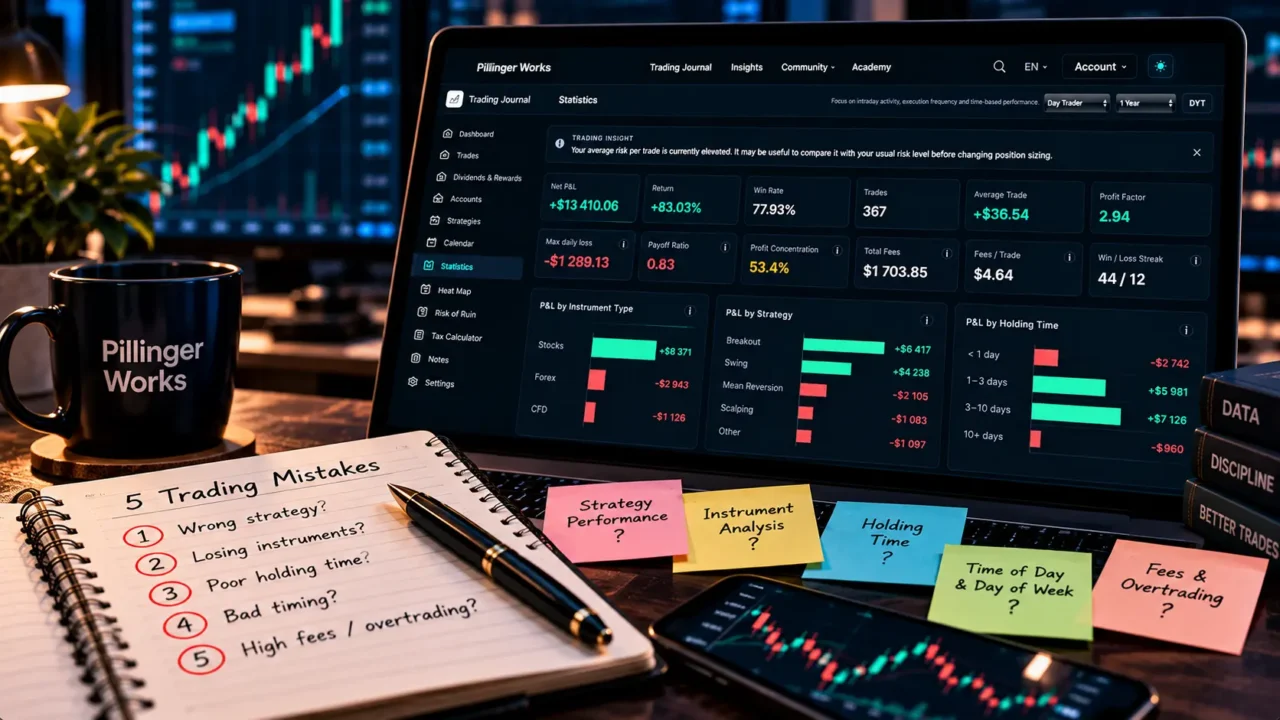
You can probably recall your biggest winning trade, a painful loss, or a position you closed too early. But do you remember accurately which of your strategies performs best? Which instruments cost you the most? Or how the results of short-held and long-held trades compare?
Memory is not a neutral database. Unusual and emotionally intense events are easier to remember, while the details of ordinary trades can blur together. That can create a confident but inaccurate picture of how you actually trade.
Data cannot make decisions for you, and it does not explain everything on its own. It can, however, reveal patterns that are almost impossible to identify reliably from memory alone.
You use different strategies, but their results are mixed together
You may feel certain that one of your strategies is clearly better than the others. But if you do not separate trades by strategy, the combined result can hide important differences.
One strategy may generate modest gains consistently, while another looks strong overall because of a few large winners, despite larger drawdowns and more volatile results. A strategy may also work well only under certain market conditions.
What should you review? Compare net P&L, profit factor, win rate, average winning and losing trade, and maximum drawdown for each strategy. Check the trade count and time period too: a handful of trades is not enough to support sweeping conclusions.
What mistake might this reveal? You may be overusing a strategy that is actually dragging down your performance—or neglecting a method that behaves more consistently under the right conditions.
You regularly lose more on certain instruments
Familiar or exciting instruments can easily become favorites. You may prefer a particular stock, currency pair, or CFD because you watch it closely or feel you know it well. That does not automatically mean it produces your best results.
Spread, volatility, liquidity, trading hours, and sudden price moves create different challenges for different instruments. The impact of costs and execution can also vary.
What should you review? Group trades by asset class, instrument, or market. Compare net results, costs, profit factor, and drawdowns over reasonably comparable periods and with a sufficient number of trades.
What mistake might this reveal? Costs or excessive risk on a favorite instrument may regularly eat into your gains. Or you may discover that the instrument itself is not the issue—the way you trade it is.
Your holding period does not fit your strategy
Some traders assume winning trades should be held longer and losing trades should be closed quickly. That can be a sensible principle in many situations, but the actual rules must fit the strategy. A short-term setup may not benefit from being left open for days out of hope; a longer-term position may be closed too early if every small pullback feels threatening.
Memory often preserves the most exciting moment of a position, not the result across its entire holding period. That makes it difficult to judge mentally which time horizon works best.
What should you review? Compare results by holding period—for example, within a few hours, within a day, for several days, or longer. Review average outcome, costs, and drawdown as well. Define the groups in a way that fits your trading style.
What mistake might this reveal? You may routinely hold losing trades longer than winners, or your exits may not match the original plan. Data can help determine whether this is a genuine pattern or just a few memorable cases.
Certain times of day or days of the week hurt your results
You may feel that you trade better in the morning or make more poor decisions on Fridays. It is easy to turn impressions like these into rules—even when very little data supports them.
Time of day can affect liquidity, volatility, and sensitivity to news. But results are also influenced by the instrument, strategy, and sample size. It is therefore unwise to generalize from a single bad week.
What should you review? Break trades down by time of day, weekday, or—if relevant—time relative to the market open. Check trade counts, costs, and whether one large result distorts the group average.
What mistake might this reveal? You may be more tired or rushed at certain times, or you may be trading in market conditions that do not suit your strategy. You may also find that the suspected pattern is too weak to justify a change.

Would like to learn about the market and trading?
You are in the best place! Our 5 levels Academy system free for everyone. After a short registration, you can easily follow your learning process and There is also a certificate for your perseverance! The whole from beginners to expert level.
Costs and overtrading quietly reduce your performance
The fees on individual trades often seem insignificant. A few dollars in commission or a small spread can disappear into the day’s results. But when you place many trades, these costs accumulate and can consume a meaningful share of your gross gains.
Overtrading does not simply mean placing a lot of trades. It becomes a problem when additional trades do not meaningfully improve results while creating extra costs and decision risk.
What should you review? Examine total fees, cost per trade, trading frequency, and net results. Compare periods of higher and lower activity, while accounting for market conditions and the nature of your strategy.
What mistake might this reveal? You may be paying too much for low-quality entries, or your gross profits may look healthy while your actual result after costs is much more modest.
How to avoid misleading conclusions
Data is valuable, but it is easy to misread. A few principles can help you avoid building new rules around random patterns:
• **Use a sufficient sample.** A handful of trades may not reflect how a strategy behaves over the long term.
• **Compare similar periods.** Different market conditions can make two groups of results difficult to compare directly.
• **Include costs.** Gross results can differ significantly from the profits you actually keep.
• **Look beyond one metric.** Alongside net P&L, review profit factor, win rate, drawdown, and trade count.
• **Separate correlation from cause.** If your results are weaker on a particular day or instrument, that does not prove the day or instrument caused the difference.
Turn the insight into a concrete next step
Choose one question that could genuinely affect your trading. For example: which strategy performs most consistently, which asset class carries high costs, or which holding period is associated with a weaker average result?
Review the data, check the sample size, and define one testable change. Do not change everything at once. If you alter a rule, record when and why you did it, then review later whether the new approach actually improved your process.
The Trading Journal / Trader Pro can help organize trades by strategy, asset class, direction, and holding period, so you do not have to evaluate your performance from memory alone. The Academy can provide a structured learning framework for understanding performance metrics, risk management, and a consistent trading process.
Final thoughts
Trading data will not automatically tell you what to do. It can help turn impressions into questions you can test, so your decisions are not based on a few memorable trades.
The goal is not to create a new rule for every statistical difference. It is to identify persistent, recurring patterns and make changes only when the data and circumstances justify them.
A good trading journal is worth its weight in gold! Yet, for the price of just one or two coffees a month, we give you access to the full Pillinger Works Trading Journal. You’ll be surprised by how much valuable insight and knowledge you can unlock from your own trading data with our help!
Important note
This article is for educational purposes only and does not constitute investment advice. Trading involves the risk of loss, and past performance does not guarantee future results.