Trading Performance
Even a Good Strategy Can Fail Through Poor Execution
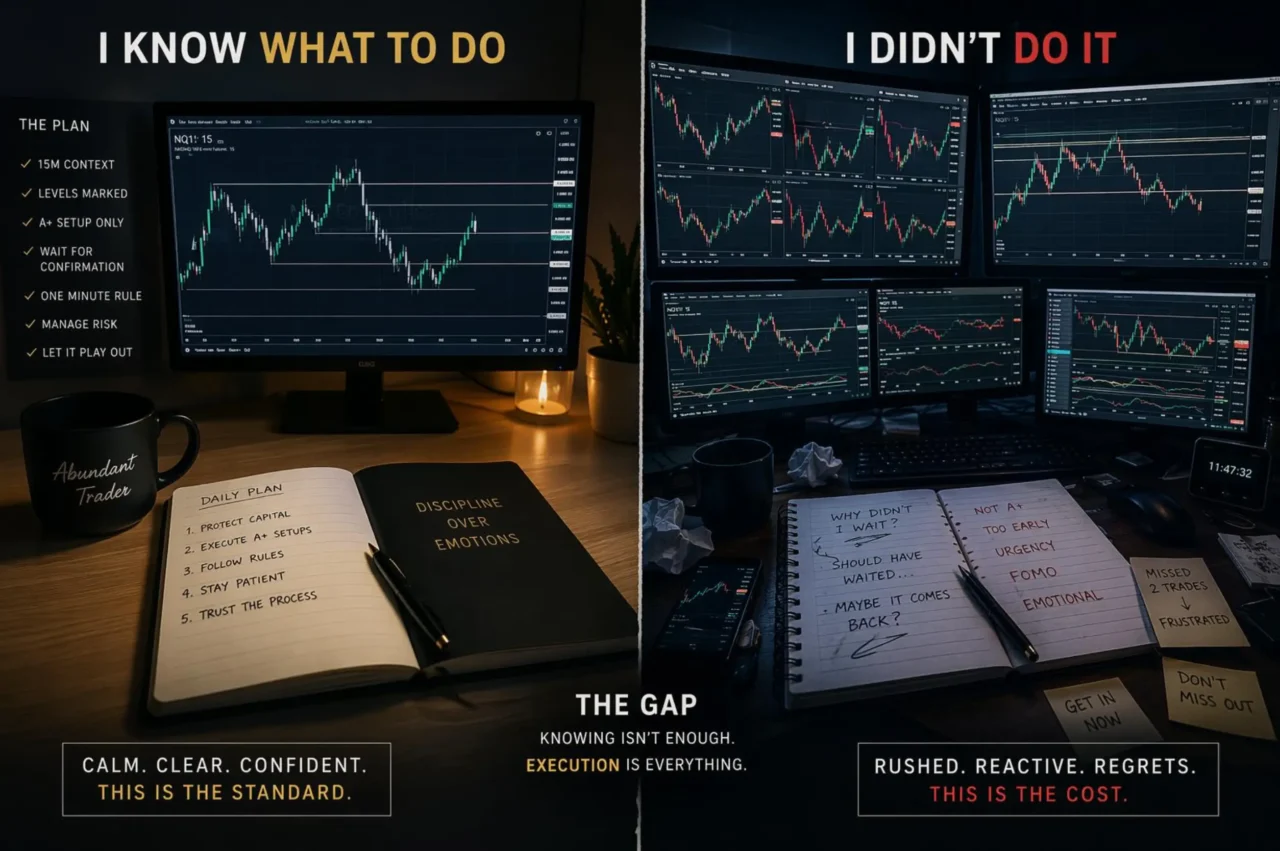
You can have a carefully designed trading strategy, with clear entry conditions, predefined risk, and tested exit rules—and still get results that differ from what you expected. One reason is that having a strategy and executing it consistently are two different things.
A plan may look consistent on paper. In live markets, however, uncertainty, fast price moves, fear of missing out, the urge to make back a loss, and the temptation to lock in profits too early can all influence decisions. Each choice may seem small, but repeated across many trades, these deviations can add up.
A strategy is not the same as execution
A strategy defines the market conditions you look for, the criteria for entering, the amount of risk you accept, and the rules that guide your exit. Execution shows whether you actually follow those rules in practice.
For example, your rules may require confirmation before entry, but impatience pushes you into the trade early. Or you move your stop-loss farther away because you do not want to accept the loss. At other times, you close a winning trade before its target while holding a losing position longer than your plan allows.
One deviation does not necessarily indicate a problem. But if you regularly depart from your own rules, you are no longer trading the same strategy whose results you previously evaluated.
Four common execution mistakes
1. Entering before the signal. The market starts moving and you worry about missing out. You enter before your criteria are met, taking a position that your strategy has not actually confirmed.
2. Moving the stop-loss after entry. A loss feels uncomfortable, so you move the stop farther away or remove it. This is not just a technical adjustment: it changes the risk you originally agreed to take.
3. Taking profits too early. When the price moves in your favor, you fear the gain will disappear. You exit before the planned target, while allowing losing trades to remain open longer than intended. Over time, this can weaken your average win-to-loss relationship.
4. Trading to recover a loss. You quickly open another trade to make up for the previous one. The next entry can then be driven by frustration rather than by a valid market setup.
Why the problem is hard to spot
Human memory tends to focus on spectacular wins and painful losses. After an individual trade, it is easy to explain why breaking a rule seemed justified. It is much harder to notice the pattern created by repeated deviations.
Short-term results can also be misleading. A trade taken against your rules may still make money, while a correctly executed trade may still lose. So it is not enough to ask whether a trade was profitable. You also need to ask whether the decision followed your plan.
Our memory lies, but data never does!
Measure results and process separately
A useful review answers two separate questions: What result did you achieve, and how consistently did you follow your plan? P&L, return, costs, and other performance metrics help explain the first. To understand the second, you need information about your decisions and rule adherence.
For each trade, consider briefly recording:
• whether the entry criteria were met;
• whether you used the planned level of risk;
• whether you changed the stop or target, and why;
• whether the exit followed your rules;
• whether emotions or outside distractions influenced the decision.
You do not need to write a long journal entry every time. A few consistently recorded details can be more useful than an elaborate but irregular account.
Separate mistakes from normal losses
Consistent trading does not mean every trade must be profitable. Even a sound strategy includes losing trades, and a valid entry can still reach its stop-loss.
The important thing is to distinguish the natural outcomes of a strategy from execution mistakes. If you followed your rules, a loss alone does not prove that your decision was wrong. If you broke your plan, a profitable outcome does not necessarily mean the decision was good.
This distinction helps prevent you from constantly rewriting your strategy in response to a handful of random outcomes.
A simple weekly review
At the end of the week, select a few trades and look beyond their financial results. Ask yourself:
• Which rule did I follow consistently?
• In what situations did I deviate from my plan?
• What triggered the deviation: impatience, fear, overconfidence, or an external distraction?
• What is the one behavior I want to improve next week?
Focus on one recurring issue at a time. If you try to change too many things at once, it becomes harder to tell what actually helped.
Final thoughts
A good strategy is an important foundation, but it cannot guarantee that your live trading will match your expectations. Results are shaped by the strategy, risk management, costs, and execution together.
A trading journal helps you see not only your account balance, but also the decisions behind it. The Pillinger Works Trading Journal can help you organize and review your trades and performance. If you want to develop your rules and understanding of trading concepts in a structured way, the Academy’s learning materials can provide a framework for that process.
Important note
This article is for educational purposes only and does not constitute investment advice. Trading involves the risk of loss, and past performance does not guarantee future results.