The Stories of John Fitzgerald Doe
12. The Month He Traded Less but Performed Better
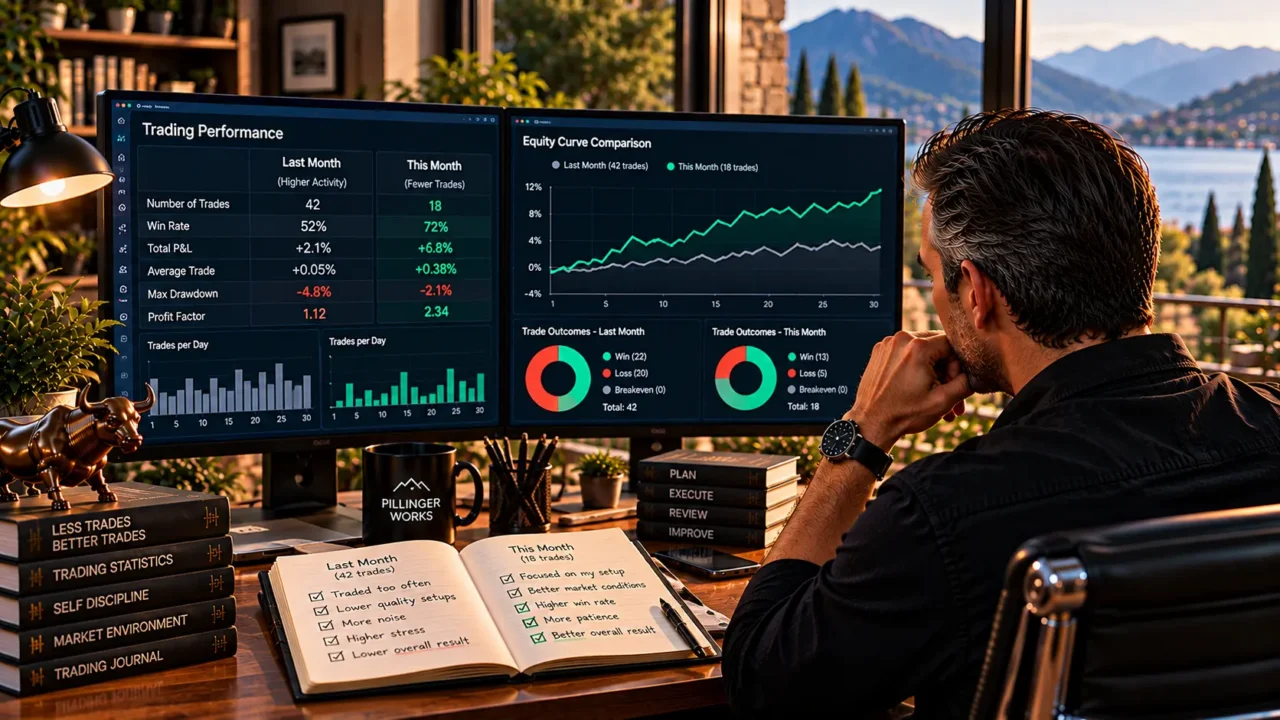
For a long time, John Fitzgerald Doe believed that a truly good trading week had to be a busy one.
If he opened several trades from Monday to Friday, watched the charts, adjusted orders, and felt pleasantly exhausted by evening, he felt productive. But if he checked the market only a few times and ended the day without placing a single trade, an uncomfortable sense of incompleteness stayed with him.
Doing nothing seemed suspicious. And when something seemed suspicious in trading, John usually tried to fix it quickly.
Over the past few months, however, a lot had changed. He no longer jumped into every dramatic move, tried to win back a losing trade at any cost, or treated the market as a personal challenge he had to defeat.
One Friday afternoon, he opened his Trading Journal to review the past month. Not because something had gone wrong. Quite the opposite: he wanted to see whether trading more calmly was actually reflected in his results.
At first glance, the record offered no spectacular story. There was no heroic trade that saved everything, and no week in which every entry had been perfect. There were profitable positions, losses, and a few exits he would handle differently in hindsight.
John leaned back and realized that, for the first time, he wasn’t looking for a single number. Instead of asking how much he had made that month, he asked: which of my decisions were genuinely good, and which had merely ended well by luck?
He compared his trades with his own rules. He checked whether each had a clear entry condition, whether he knew in advance what would invalidate his idea, and where he had deviated from his plan. He also considered the market conditions in which each decision had been made.
A pattern gradually emerged. His busiest days were not necessarily his best. He had opened some weaker trades simply because the market was moving and he didn’t want to miss out. His better decisions, by contrast, usually came when he patiently waited for his own conditions and accepted that an opportunity wasn’t his just because it existed.
He didn’t conclude that fewer trades automatically produced better results. He saw that, for him, well-reasoned trades that followed his plan were worth more than trades prompted by boredom or fear of missing out.
John smiled. This insight wasn’t as dramatic as a big win. It wouldn’t make an exciting screenshot, and telling his friends, “I didn’t trade today because there was no reason to,” wouldn’t sound particularly impressive.
Still, something important had happened. On one losing trade that month, for example, his stop was hit exactly as planned. In the past, he would often have searched for another entry to win the money back quickly. This time, he closed the position, recorded what he needed to, and didn’t try to comfort himself on the next chart.
The following week, an acquaintance asked how many trades he’d made lately. John almost blurted out the number, as if it proved something on its own. Then he shrugged.
“Fewer than before. But my goal isn’t to do something every day anymore.”
His acquaintance raised an eyebrow.
“Then how do you know you’re doing a good job?”
John thought for a moment. In the past, he probably would have pointed to his profit. Now he didn’t want to pretend that one month could prove everything.
“You can’t draw big conclusions from one month. But I can already see that a good decision isn’t good just because it made money—and it isn’t better just because there are lots of them. I look at whether I followed my plan, and what my data shows over time.”
As he said it, he realized this was no longer just another rule in his head. It was becoming part of the way he thought.
That evening, he felt no need to open the charts one more time. Reviewing the month hadn’t made him certain that his next trade would be profitable. But it had strengthened his belief that he didn’t need to react to every move or confuse activity with performance.
John Fitzgerald Doe was slowly learning that patience in trading wasn’t dead time. Sometimes the best decision is the one that leaves no visible trace at all.
What can we take away from John’s story?
• More trades do not automatically mean better performance. Use your own data to examine the conditions in which your method works well.
• Evaluate more than the outcome. Consider decision quality, adherence to your rules, and the market environment.
• A losing trade executed according to plan is not necessarily a bad decision; a profitable trade taken outside the plan is not necessarily a good one.
• A Trading Journal can help reveal your patterns, while the Academy can organize the knowledge needed to interpret them. Neither guarantees profit, but both can support more deliberate decision-making.
Educational content only; not investment advice. Trading involves risk and losses may occur.