The Stories of John Fitzgerald Doe
10. The Strategy That Only Worked on Paper
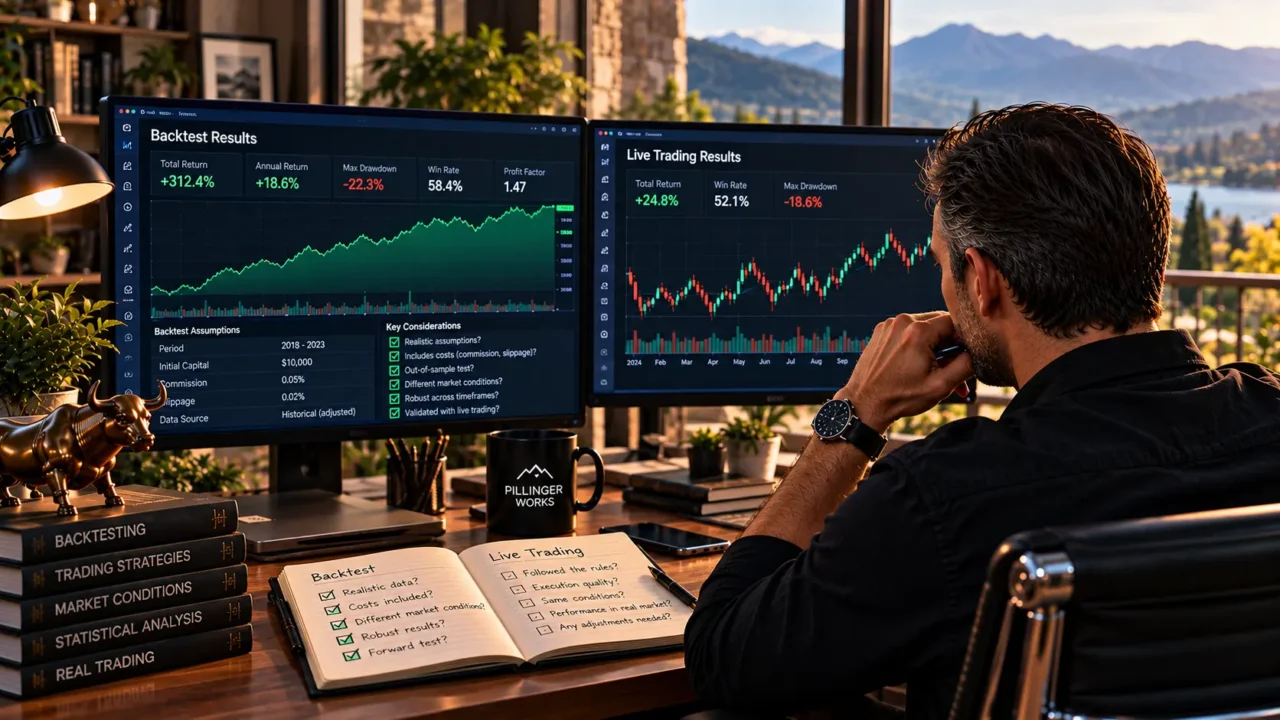
John Fitzgerald Doe was no longer the trader who jumped at every market move. He had learned to wait for suitable setups, define his risk in advance, and stay calm even when a trade ended in a loss.
That was exactly why he was so proud of his new strategy.
One weekend, he found a method and tested it on historical charts. He went back through months of price action, marked entries and exits, and the results looked impressive. The strategy showed many winning trades, the losses seemed manageable, and the equity curve rose almost beautifully.
John leaned back in his chair, adjusted his watch, and smiled.
“I think I’ve found something,” he said.
There was only one small step left: trying it in the live market.
The Past Always Looks More Orderly
John began by trading the strategy with a small amount of capital. The first few signals did not unfold as they had in the backtest. On one entry, price had already moved by the time he noticed the signal. On another, spread and execution meant he got a worse fill than the chart-based test had assumed.
The following week, some signals simply did not offer entries as clean as the historical examples. John began to feel as if the market were deliberately making things difficult for him.
Then he noticed something: during the backtest, he knew exactly where each candle ended, how price moved afterward, and which signals had eventually worked. Live, he had to make decisions using only the information available at that moment.
The chart looked clean in hindsight. In reality, decisions had to be made in real time, with costs and uncertainty.
John Did Not Abandon the Strategy Immediately
The old John might have discarded the method at once, or started changing its rules to make the next trade work out better. This time, he remembered what he had learned about using his Trading Journal: he should not draw rushed conclusions from a handful of results.
So he documented every trade. He recorded whether the signal had genuinely occurred, the price at which he entered, the costs involved, whether he had followed his rules, and whether live execution differed from the test.
He did not hide the uncomfortable data. If a trade deviated from the plan because of his own mistake, he recorded that too. If a valid signal produced a loss, he did not automatically label it a bad decision.
After a few weeks, he was no longer asking only whether the strategy was profitable. He was examining how closely the assumptions in the test matched what he experienced in live trading.
Assumptions Were Hiding Behind the Numbers
At the Academy, John revisited the material on strategy evaluation and the limitations of testing. He understood how easy it was to overvalue historical results, especially when rules were adjusted afterward to fit price movements that were already known.
A good backtest does not prove that a strategy will perform similarly in the future. Trading costs, execution, changing market conditions, and how closely the test reflects real decision-making all matter.
John also accepted that a handful of trades could not provide a final verdict. A method needed to be evaluated using predefined rules, a sufficient body of observations, and cautious risk. And if the data contradicted his idea, it was not the data’s job to conform to it.
The Real Success Was Not That Every Test Worked
John eventually improved his testing process. He documented the rules in advance, accounted for costs, and kept test results separate from live trading experience. He did not increase his risk simply because the historical charts looked impressive.
The strategy was not perfect. There were conditions in which it performed worse than he expected, and some assumptions needed to be reconsidered. But John no longer saw this as a personal failure. The purpose of testing was to discover weaknesses before risking too much capital.
That was when he truly understood that a test was not meant to prove he was right. It was meant to reveal when he might be wrong.
John’s Growth
In the past, John had been quick to treat convincing results as proof. Now he asked what assumptions had produced them, which costs might have been omitted, and whether the method could realistically be followed in live conditions.
The Academy helped him interpret test results critically. His Trading Journal connected the idea on paper with real decisions: it showed where he followed the plan, where he deviated, and what happened in practice.
John did not become cynical or lose his enthusiasm for developing strategies. He simply learned that a good trader is not in love with his own idea. A good trader is curious about whether the idea can withstand scrutiny.
John’s Takeaway
Historical results are useful information, not a promise about the future. A strategy’s value is not determined by how attractive its backtest chart looks, but by how sound the test is, how realistic its assumptions are, and how the method behaves during real execution.
**The lesson:** don’t test a strategy just to prove it works. Test it to find out honestly under what conditions it might work — and when it might not.
Educational note: This story is for informational and educational purposes only and does not constitute investment advice. Past performance does not guarantee future results.