The Stories of John Fitzgerald Doe
18. The House He Didn’t Need to Renovate to His Own Taste
The house deal remained on hold for several weeks. John did not raise his offer, and the seller did not change position. Then the estate agent called to say the owner was willing to talk again. Not because John had persuaded them, but because the house still had not sold.
John reopened his earlier calculations and updated them with the latest professional quotes. The maximum purchase price at which the project remained acceptable had not changed. The roof had not become cheaper, the damp had not disappeared, and the area had not suddenly become more valuable. Only the seller had become more open to negotiation.
At the next conversation, John made his offer. The seller tried to bargain, but John did not let the negotiation make him forget his calculations. They eventually agreed on a figure within the limit he had set, and they checked the terms once more before signing. John did not see acquiring the house as a victory. It felt more like the beginning of the part where his decisions would have real consequences.
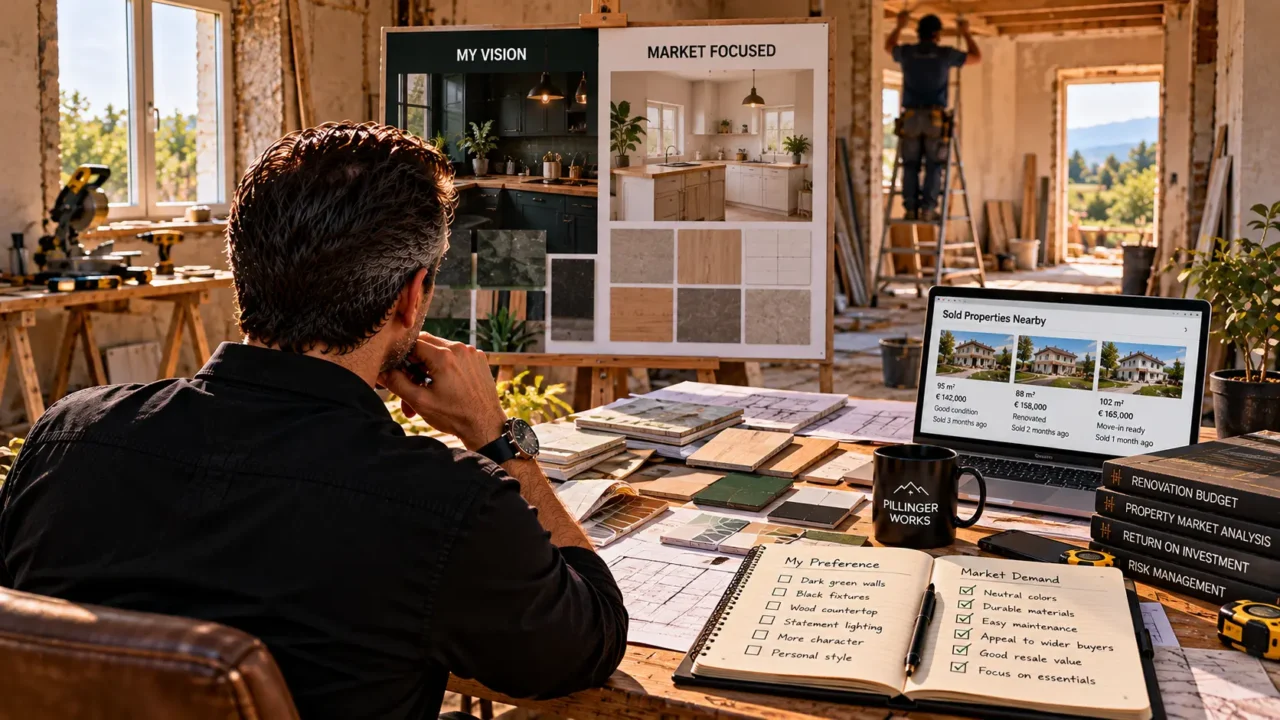
After receiving the keys, his first temptation had nothing to do with the roof or drainage. It was the interior. He could already picture dark green walls, distinctive lamps, a thick wooden worktop, and modern black fixtures. It would have looked exactly like a place he would enjoy living in himself.
One afternoon, he walked through the rooms with the local estate agent and a contractor. The agent asked who the most likely buyers might be. A young couple, a family looking for its first home, or someone moving out of the city who did not want to take on a major renovation immediately? The answer was not certain, so John did not treat any one idea as fact.
Instead of choosing his favourite finishes straight away, he reviewed comparable homes that had sold nearby and spoke with local professionals again. What condition were buyers accepting? Which rooms mattered most? What price differences appeared between tidy, neutral homes and properties with expensive, highly individual choices? The available evidence could not answer every question with certainty, but it made one thing clear: personal taste was not the same as market demand.
Even so, John found it difficult to let go of his own ideas. The unusual kitchen and dark colours were not merely attractive to him; he felt they would give the house character. Distinctive choices made the finished result easier for him to imagine than a simple, restrained interior. Then he asked himself: did he want these features because they would add value for the likely buyer, or because he would choose them for himself?
In his budget, he separated essential repairs, work needed to make the house comfortable, contingency for completing the renovation, and optional cosmetic upgrades. He compared two versions. One included more expensive, distinctive materials and custom details; the other used durable, neutral, easy-to-maintain finishes. The difference was not only the final cost: the more expensive version required more time and more decisions that would not necessarily increase the sale price by a similar amount.
Based on professional advice and local comparisons, John prioritised the essential work: fixing the cause of the damp, repairing the roof, making the electrical and plumbing systems safe, and then creating a clean, usable interior. He removed striking but non-essential details from the plan for now. Not because he had abandoned his taste, but because this was not a self-expression project. He needed to create a product for which a real buyer would be willing to pay an appropriate price.
He recalculated the expected outcome. The optimistic resale price in his earlier plan was no longer treated as guaranteed income. He looked separately at the purchase price, renovation costs, transaction and holding costs, contingency, and possible sale prices. He also accounted for the fact that if selling took longer than expected, time itself would cost money. The spreadsheet did not promise a profit; it showed the conditions under which the project might make sense.
The renovation became less dramatic than John had first imagined. He chose a cleaner, more neutral direction that better matched local demand. He still allowed quality and character where these genuinely improved durability or usability. The difference was that every extra cost now had to justify its place in the plan.
Unexpected issues still appeared during the work. Once a section was opened up, it became clear that a small area needed more repair than expected. John did not hide the cost in his spreadsheet or automatically draw on reserves kept outside the project. He updated the budget, discussed the options with the contractor, and postponed a non-essential upgrade. The project moved more slowly than he wanted, but his decisions remained grounded in the actual numbers.
As the house took shape, John realised that his hardest decision had not been about the colour of a wall or the price of a tap. It was whether he could separate his own desires from the purpose of the investment. In the stock market, he had learned that he did not need to react to every move and that not every opportunity was his to take. Now he was learning the same lesson with property: he did not need to buy everything he liked or carry out every idea to make a sound decision.
The house was not on the market yet, and John did not book a profit in advance. He focused on the next stage of the renovation while leaving the final question open: what would the actual costs and buyer interest ultimately prove? His first major property decision was not about designing the house he would dream of living in. It was about whether he could make decisions based on the numbers, local demand, and the project’s purpose—even when that meant setting aside some of his own taste.
Academy connections: testing assumptions, clarifying objectives, and separating expected outcomes from actual costs.
This story is for educational purposes only and does not constitute investment or financial advice.